
Presale bonus
2027 Design-Build Field Notes
Pre-order by November 30 and get Tyler's post-RE+ thoughts on the changes that are new this year or coming in 2027: the Section 232 minimum import price, FEOC, domestic content, and FCC inverter restrictions, plus what they mean for procurement, value engineering, and placing projects in service by the end of 2027.
Field notes, not tax or legal advice.
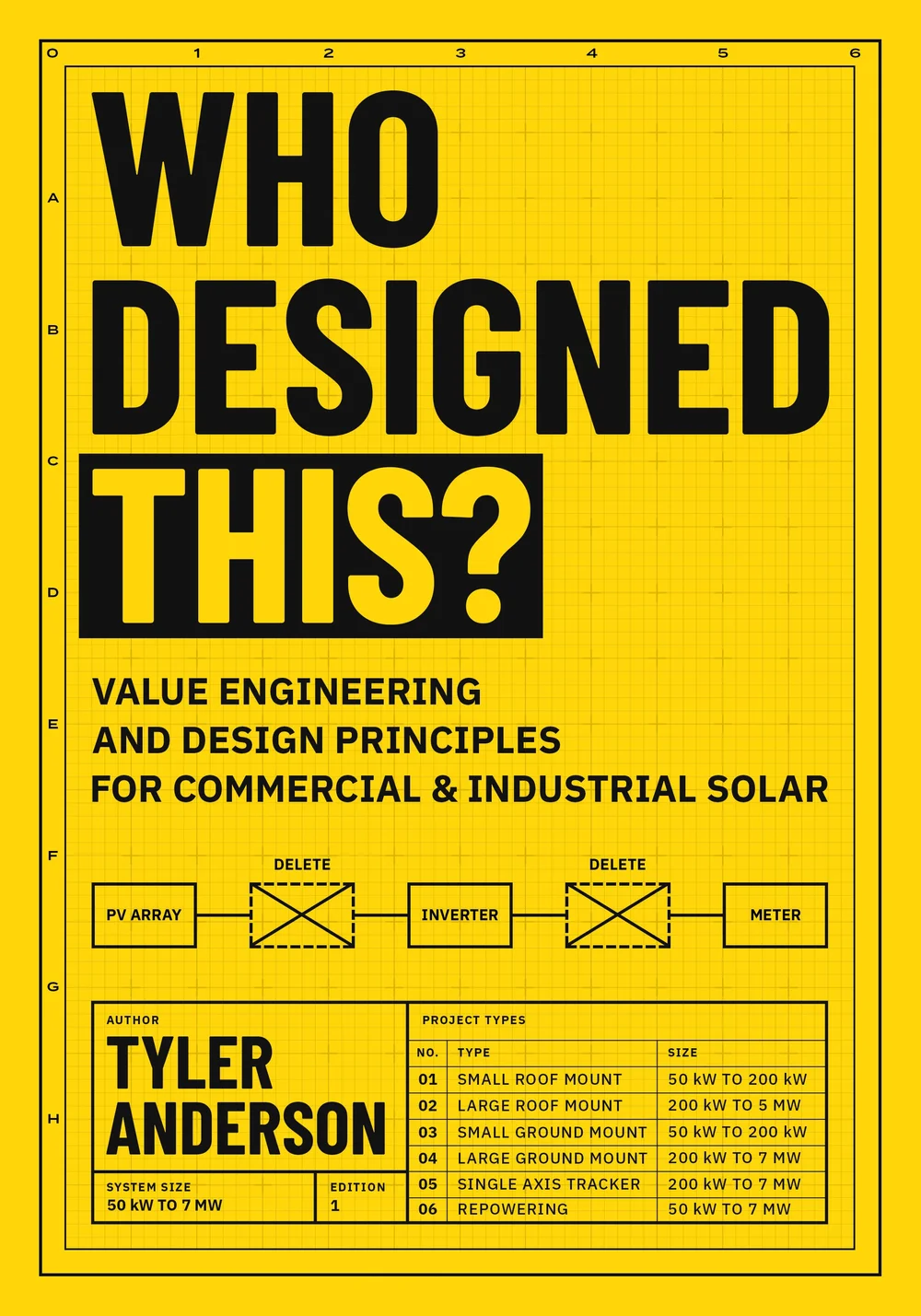
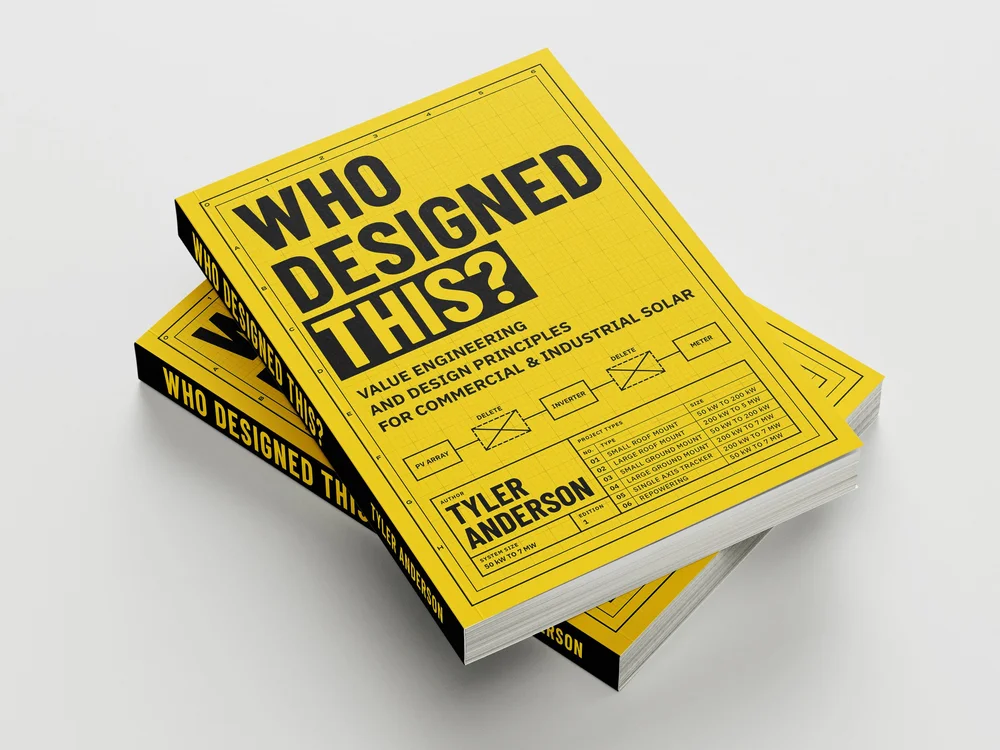
Who Designed This?
Value Engineering and Design Principles for Commercial and Industrial Solar
By Tyler Anderson
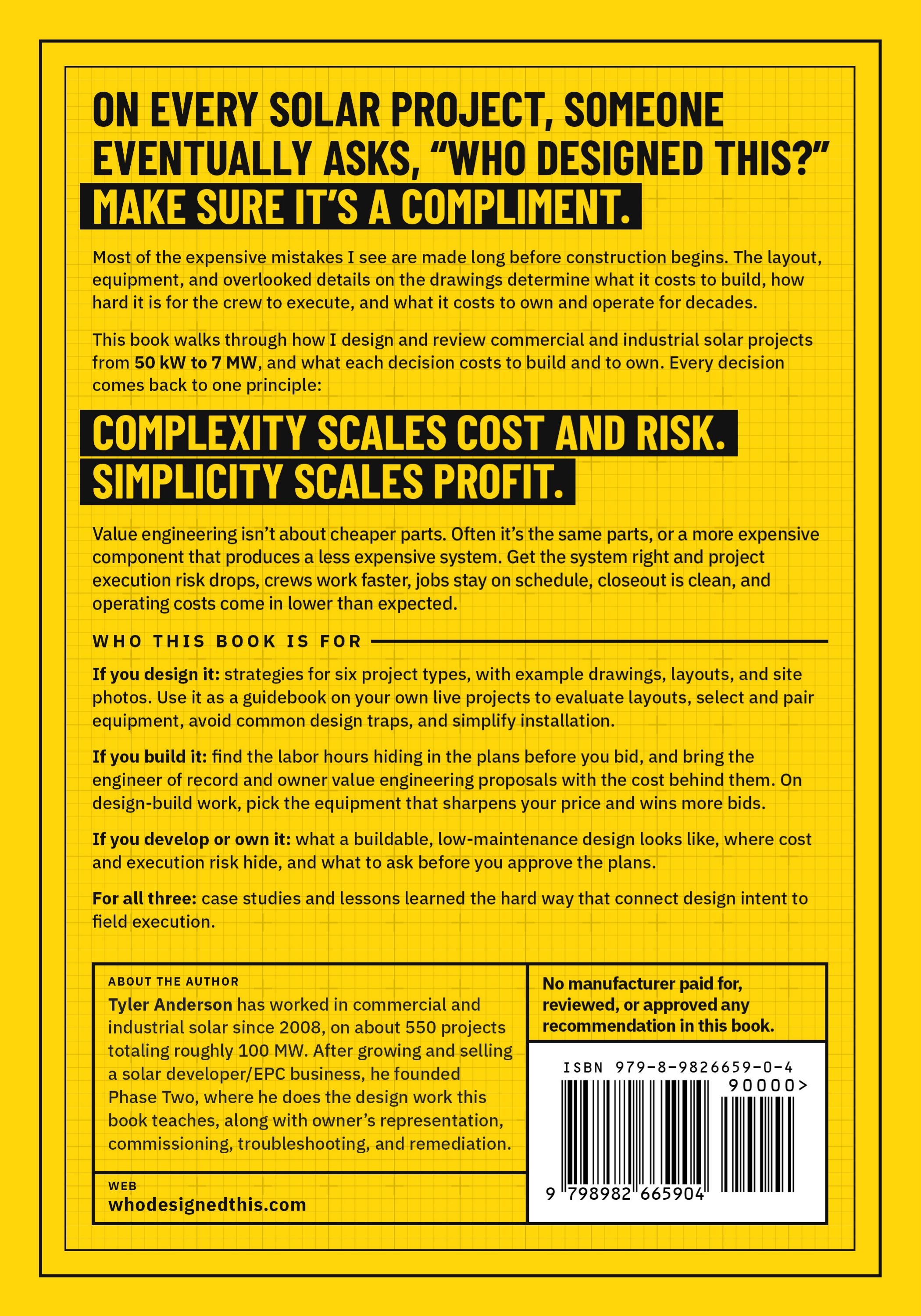
On every solar project, someone eventually asks, "Who designed this?" Make sure it's a compliment.
How to design and review commercial and industrial (C&I) solar from 50 kW to 7 MW, and where cost and execution risk hide in the drawings.
- Six project types from 50 kW to 7 MW: small and large roof mount, small and large fixed tilt ground mount, single axis tracker, and repowering
- The design choices that add labor hours, execution risk, and decades of service burden, and what to do instead
- Example drawings, layouts, and site photos to work from on your own live projects
- Full color, more than 200 pages, 7 x 10 inches
$79
$129
RE+ presale price through November 30. $129 after.
Pre-Order for $79Ships spring 2027. Free US shipping. Cancel for a full refund any time before your book ships.
Every pre-order includes a code for $50 off a call with Tyler.
Your card is charged when you place your pre-order. Sales tax is added at checkout. Outside the US? Email info@phasetwosolar.com for shipping.
Why I wrote it
Most of the expensive mistakes I see are made long before construction begins. The layout, equipment, and overlooked details on the drawings determine what it costs to build, how hard it is for the crew to execute, and what it costs to own and operate for decades.
Tyler Anderson
Complexity scales cost and risk. Simplicity scales profit.
Value engineering isn't about cheaper parts. Often it's the same parts, or a more expensive component that produces a less expensive system. Get the system right and project execution risk drops, crews work faster, jobs stay on schedule, closeout is clean, and operating costs come in lower than expected.
Every unnecessary component adds installation time, commissioning steps, failure points, and decades of service obligations.
Five questions for every design decision. Does it reduce:
- 1Installation labor?
- 2Long-term service complexity?
- 3Procurement and replacement friction?
- 4Failure points?
- 5Cognitive load in the field?
Who this book is for
If you design it
Strategies for six project types, with example drawings, layouts, and site photos. Use it as a guidebook on your own live projects to evaluate layouts, select and pair equipment, avoid common design traps, and simplify installation.
If you build it
Find the labor hours hiding in the plans before you bid, and bring value engineering proposals to the engineer of record and the owner. On design-build work, pick the equipment that sharpens your price and wins more bids.
If you develop or own it
What a buildable, low maintenance design looks like, where cost and execution risk hide, and what to ask before you approve the plans.
For all three: case studies and lessons learned the hard way that connect design intent to field execution.
Start at the beginning. Keep it open while you design.
Read Part I first. Then keep the book beside the project you are designing. All six project chapters use the same structure, so you only learn the layout once.
Part I: The discipline
Part II: Project types
Start at the service entrance, which sets the ceiling, then compare the installed cost of string, micro, and optimized-string architectures.
How major inverter platforms implement power line communication (PLC) differently, where each breaks down in the field, and what that means for commissioning.
Driven piles, ground screws, or ballast, priced in labor hours and equipment time.
Pile-driving productivity, transformer protection, and commissioning that an asset buyer will accept.
When tracking pays over fixed tilt once the added parts, controllers, communications, and service burden are priced against the production gain, and when it doesn't.
When to repower versus repair as 2012 to 2018 systems hit inverter failure and obsolescence.
Chapter list may change before printing.
What's in each project chapter
- 1
When to use it
The site, size, and offtaker conditions that point to this project type. - 2
Red flags
What disqualifies or reprices a project before design starts. - 3
Design sequence
The common choice, the value-engineered alternative, and the difference in installed cost, labor hours, and 30-year service burden. - 4
Value traps
Flagged at the decision where they occur, then collected at the end of the chapter. - 5
Example drawings, layouts, and site photos
Examples to work from while you design your own live project. - 6
Case study
An anonymized project showing the design as proposed, the design as built, and what the difference cost or saved.
What this edition doesn't cover: energy storage, carports and canopies, or project finance and power purchase agreement (PPA) structuring.
Questions
When will my book ship?
Estimated ship: spring 2027. We'll email you if that changes.
How long is the $79 price good?
Through November 30. After that, the book is $129.
What is the presale bonus?
Tyler's field notes from RE+ 2026 on the changes that are new this year or coming in 2027: the Section 232 minimum import price, FEOC, domestic content, and FCC inverter restrictions, plus what they mean for procurement, value engineering, and placing projects in service by the end of 2027. Everyone who pre-orders by November 30 gets them by email. They are field notes, not tax or legal advice.
Where do you ship, and what does it cost?
Shipping is free to US addresses. For orders outside the US, email info@phasetwosolar.com for pricing. Iowa sales tax is added at checkout.
When will I be charged?
Your card is charged when you place your pre-order.
Can I cancel?
Yes. You can cancel for a full refund any time before your book ships by emailing info@phasetwosolar.com.
Is there an ebook?
Not at launch. This edition is print only.
How do I use the $50 off a call?
Your order confirmation email includes a code. Enter it when you book a call with Tyler.
Design it simpler. Build it faster. Service it for 30+ years.
$79 through November 30. $129 after. Ships spring 2027.
Pre-Order for $79Order by November 30 for the presale bonus: 2027 Design-Build Field Notes.
Cancel for a full refund any time before your book ships.
Not ready to order?
Join the list. We'll email you a sample chapter when it's ready, and tell you when the book is close to shipping.
Use the signup form at the bottom of this page.
Need help on a live project?
Book an hour with Tyler. Bring Me Your Problem is one prepared hour on your project. Ask Me Anything is one hour with no prep and no agenda. Every pre-order includes a code for $50 off.
Phase Two also does design optimization, procurement, commissioning, and remediation for commercial and industrial solar. Contact Phase Two